

Natural stone brings a quiet, lasting presence to a room. It changes how light moves across a countertop, how a backsplash catches the eye, and how a bathroom feels underfoot.
But when homeowners begin comparing slabs, the question is rarely which stone is more beautiful. It is which one will still feel right after a few years of real life.
Marble and quartzite are the two names that come up most often. Both are natural stone. Both can be breathtaking. They simply live differently: and the right choice depends less on trend than on how your household cooks, cleans, and bathes.
Two stones, two personalities.
Marble is soft, luminous, and familiar. Its veining may be quiet and diffuse or bold enough to become the room’s focal point. It has a surface that feels connected to traditional architecture, while still working beautifully in a restrained, contemporary interior.
It is also a stone with a memory. Acids such as lemon juice, vinegar, wine, and tomato can etch the surface. Over time, marble may develop a patina through small changes in sheen, color, and texture. Some homeowners find that evolution appealing. Others prefer a surface that remains more visually consistent.
Quartzite begins as sandstone and changes through heat and pressure into a very hard natural stone. True quartzite is generally more resistant to scratching and etching than marble, which makes it a practical consideration for busy kitchens and hardworking surfaces.
It can also offer the movement homeowners often seek in marble: soft veining, dramatic mineral lines, warm neutral backgrounds, and a sense of depth that manufactured materials may not fully replicate.
| Consideration | Marble | Quartzite |
|---|---|---|
| Visual character | Soft, luminous, naturally expressive | Often dramatic, layered, and mineral-rich |
| Scratch resistance | More susceptible to scratching | Highly resistant under normal household use |
| Acid sensitivity | Can etch from lemon, vinegar, wine, and similar substances | True quartzite is generally resistant to household acids |
| Finish considerations | Honed finishes make wear less apparent | Honed and polished finishes are primarily aesthetic choices |
| Best fit | Homeowners comfortable with care and patina | Homeowners seeking natural movement with easier daily maintenance |
The distinction is not simply technical. It affects how the room will feel to use.
How you cook changes the answer.
If your kitchen is the center of the house: daily meals, children, guests, open wine bottles near the island: quartzite often tolerates that rhythm with less concern.
A knife, a splash of citrus, or a warm pan can create more anxiety on marble than on quartzite. Marble can absolutely work in a kitchen, but it asks for a more attentive relationship with the surface. Sealing helps reduce staining; it does not prevent acid etching. Coasters, cutting boards, and prompt cleanup remain part of the routine.
A honed marble finish can make the decision feel more forgiving. Its low-sheen surface tends to soften the appearance of etch marks and light scratches. It does not eliminate them, but it allows the stone’s natural variation to absorb more of the visual change.
The useful question is whether you want a stone you tend to: or a stone that tends to you.
How you bathe changes it, too.
Bathrooms bring water, soap, shampoo, and daily movement into constant contact with the surface. Marble remains a compelling choice for vanities, shower walls, niches, and feature details because of its depth and light response.
A thoughtful marble installation should account for sealing, water management, edge details, and the way individual pieces relate across the room. In a shower, the surface is only one part of the system. The substrate, waterproofing, slope, corners, transitions, and grout selection all contribute to how the finished space performs.
Quartzite can bring a similar sense of elevation with less concern about chemical etching. It may be especially well-suited to a bathroom vanity or feature wall where you want natural movement but prefer a more stable surface over time.
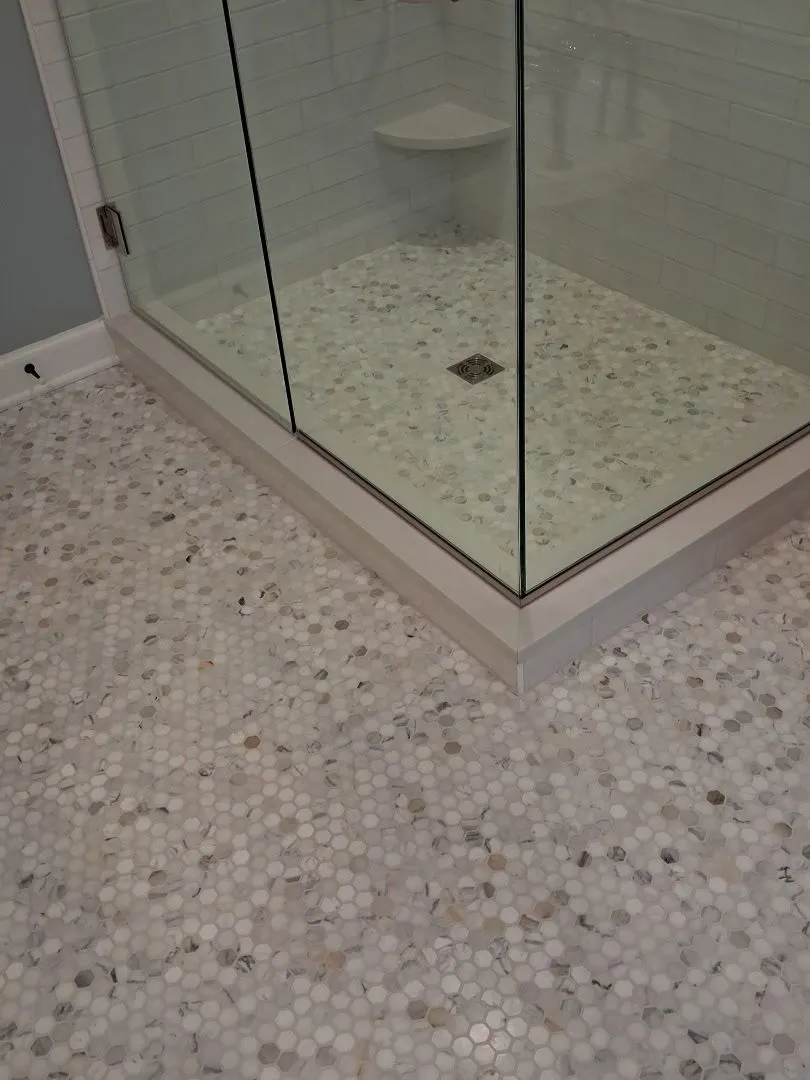
For bathroom floors, finish and slip resistance matter as much as the stone itself. A polished surface may reflect light beautifully, but a floor requires a different conversation than a wall. The transition from the main floor into the shower basin deserves particular attention as well.
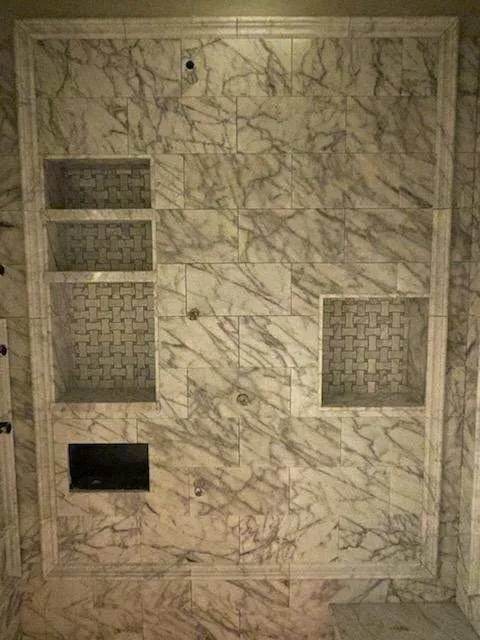
The look is closer than you think.
The visual distance between marble and quartzite has narrowed. Both can be found in creamy off-whites, taupes, warm greys, and earthy shades that align with the direction of 2026 interiors.
Warm neutrals are replacing colder, sharper palettes in many kitchens and bathrooms. Wood cabinetry, brushed metal, soft stone, and matte black accents create rooms that feel layered rather than overly matched. Marble and quartzite both work naturally within that approach.
Honed finishes are also receiving more attention. They bring a tactile, quietly refined quality to stone and help a room feel less reflective and formal. On marble, honing can make the surface more forgiving visually. On quartzite, it creates a softer interpretation of a durable material.
Then there is bookmatching.
Bookmatching places two adjacent slabs as mirror images, creating a continuous or symmetrical pattern across an island, fireplace, shower wall, or feature wall. With marble, the effect can feel almost architectural: the veining becomes a composition across the surface. Quartzite can offer the same visual impact, often with a more durable response to kitchen use.
Bookmatching is not simply a matter of placing slabs side by side. The layout must be considered before installation, with attention to vein direction, focal points, cutouts, corners, and sightlines.
The stone is only half the story.
A slab photograph cannot show the preparation beneath the surface. It cannot show whether the substrate is flat, whether a shower has been properly waterproofed, or whether a transition was planned before the first piece was set.
That is where natural stone installation becomes important.
The most beautiful material can feel unsettled if the layout is rushed or the joints do not align. A strong installation considers:
- How the stone’s movement travels across the room
- Where seams, corners, and edges will be seen
- How tile meets cabinetry, trim, glass, and adjacent flooring
- Whether the substrate is level and properly prepared
- How water will move through a shower system
- Which finish and grout color support the material
- How transitions will feel underfoot and read from the doorway
With marble installation in particular, handling and layout require care. Natural variation is part of the material’s appeal, but it should still feel intentional. A vein that turns a corner, frames a niche, or centers on a vanity can make the entire room feel more composed.
Bella Tile approaches material selection and installation as connected decisions. The question is not only whether a stone is beautiful. It is whether the surface is well-suited to the room, the maintenance expectations, and the way you want the space to age.
A practical way to decide.
Before choosing between marble and quartzite, consider the room through the lens of behavior.
1. Think about your daily rhythm.
Do you cook most evenings? Do you host often? Is the island used for homework, coffee, and quick meals as much as food preparation?
A busy kitchen may point toward quartzite. A lower-use kitchen or a homeowner who welcomes patina may be a natural fit for marble.
2. Separate visual preference from maintenance preference.
You may love the look of honed marble while preferring the everyday ease of quartzite. That is useful information, not a contradiction.
Stone selection becomes clearer when you consider both what you want to see and what you are willing to care for.
3. Bring the room into the decision.
A slab should be viewed alongside cabinetry, flooring, hardware, natural light, and the surrounding architecture. Warm earthy neutrals can shift considerably from a bright kitchen to a shaded bathroom.
If you are considering bookmatching, review the full slab pattern rather than a small sample. The most important movement may appear several feet away from the section you first noticed.
4. Confirm what you are buying.
Stone names are not always used consistently across the market. If performance matters, ask how the material has been classified and whether it should be tested for hardness and acid sensitivity before committing to a large installation.
A knowledgeable stone professional can help you understand what the surface will tolerate and where it may be most appropriate.
A calmer path to the right surface.
Marble and quartzite are not competing answers to the same question. They are different materials with different relationships to daily life.
Marble offers softness, luminosity, and a patina that can become part of the room’s character. Quartzite offers natural variation with greater resistance to the demands of a busy household. Neither is automatically right for every space.
The better choice is the one that aligns with how you cook, clean, bathe, host, and move through the room.
From our Highland Heights base, Bella Tile works with homeowners across Northeast Ohio, including Hunting Valley, Pepper Pike, Beachwood, and surrounding communities. Our marble and natural stone installation services include the planning details that allow the material to settle naturally into the space.
You can also explore recent tile and stone work in the gallery for examples of layout, transitions, texture, and finish.
Have a project in mind? Tell us what you are imagining, and we will help you talk through the surface that fits the way you live.